Mastering the art of creating perfect emulsions transforms ordinary home cooking into an extraordinary culinary experience. These stable mixtures, which bring together two liquids that naturally resist combining, form the foundation of countless beloved sauces and dressings. From the creamy richness of mayonnaise to the delicate balance of a classic vinaigrette, understanding how to coax oil and water into harmonious union opens up a world of flavour possibilities. Whether you are an enthusiastic novice or a seasoned cook looking to refine your technique, achieving that ideal smooth, homogenous consistency requires both knowledge and practice. The good news is that with the right approach and a bit of patience, anyone can master this essential kitchen skill.
Understanding the science behind emulsions
At the heart of every successful emulsion lies a fascinating battle against nature. The very essence of these mixtures involves convincing two stubborn liquids to cooperate when their molecular structure tells them to do quite the opposite. Grasping the underlying science not only demystifies the process but also empowers you to troubleshoot when things go awry. For those eager to expand their culinary repertoire and explore more advanced techniques, we invite you to visit our cuisine section where detailed guides await. The journey from understanding why liquids separate to creating silky smooth sauces is both intellectually rewarding and practically invaluable in the kitchen.
What makes oil and water incompatible
The age-old saying that oil and water do not mix holds profound scientific truth rooted in molecular chemistry. Water molecules possess a polar structure, meaning they carry both positive and negative charges that attract one another, forming strong bonds. Oil molecules, conversely, are nonpolar and lack these charged regions, preferring instead to cluster together and exclude water. This fundamental difference in molecular architecture creates what scientists call surface tension, an invisible barrier that prevents the two liquids from integrating. When you pour oil into water, the oil naturally floats and forms distinct globules, stubbornly refusing to disperse. This incompatibility presents the central challenge in emulsion creation, as the cook must find a way to overcome these powerful natural forces and persuade the liquids to remain suspended together in a stable, creamy mixture.
The Role of Emulsifiers in Stabilising Mixtures
Emulsifiers serve as the peacemakers in this molecular standoff, possessing unique structures that allow them to bridge the gap between oil and water. These remarkable compounds feature both hydrophilic regions, which love water, and hydrophobic regions, which prefer oil. When introduced into a mixture, emulsifier molecules position themselves at the boundary between oil droplets and the surrounding water, effectively reducing surface tension and preventing separation. Lecithin, discovered by Théodore Nicolas Gobley in eighteen seventy-four, remains one of the most powerful natural emulsifiers found abundantly in egg yolks and soybeans. Beyond lecithin, mucilage present in mustard, flaxseed, and chia seeds offers excellent stabilising properties, whilst casein from milk products also contributes to emulsion formation. These ingredients work tirelessly to keep oil droplets dispersed throughout the water phase, creating that coveted smooth texture. Different types of emulsions exist depending on their stability: temporary emulsions like vinaigrette separate quickly and require vigorous shaking before use, semi-permanent varieties such as beurre blanc and hollandaise last longer but remain fragile and sensitive to temperature changes, whilst permanent emulsions including mayonnaise and milk maintain their creamy, blended state almost indefinitely when properly prepared.
Essential techniques for achieving stable emulsions
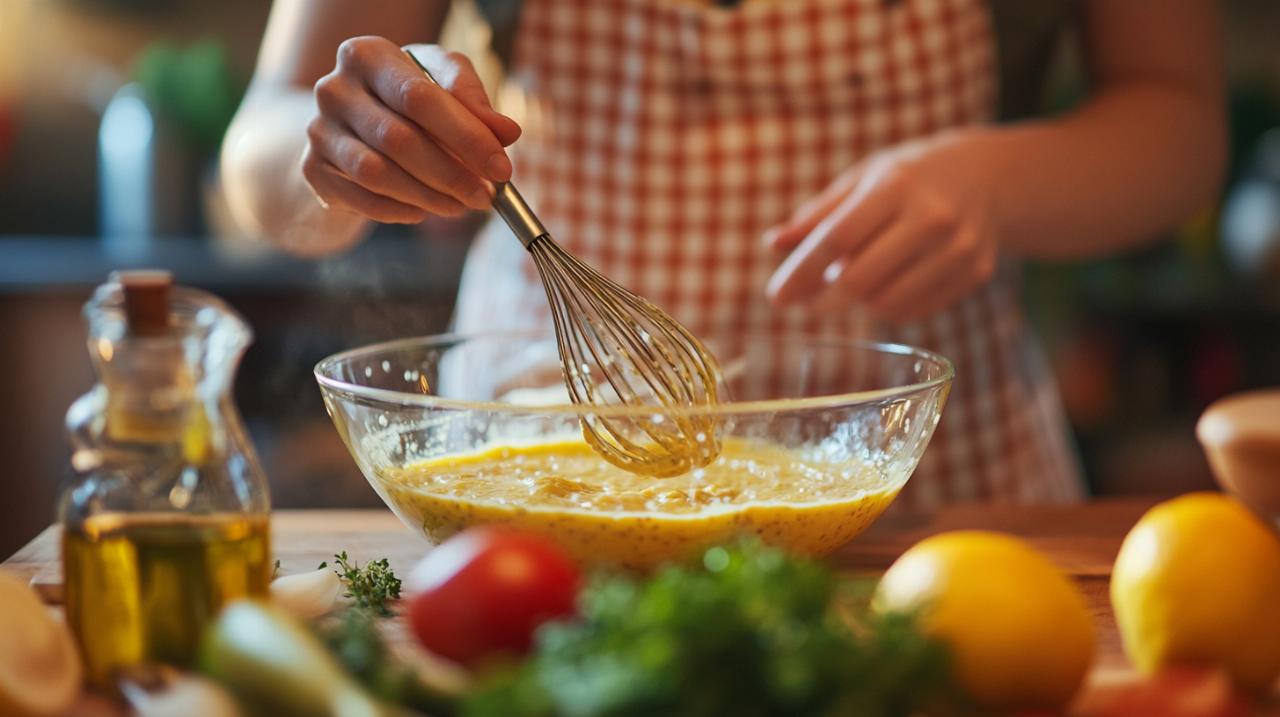
Success in creating emulsions depends not merely on understanding the theory but on executing precise techniques with care and attention. The physical process of bringing together reluctant ingredients demands both patience and consistency, as rushing through the steps often leads to disappointing results. Many enthusiastic home cooks experience initial failures, but these setbacks serve as valuable learning opportunities that refine your touch and timing. Having the proper equipment at hand makes an enormous difference, with simple tools like jars for shaking, blenders for speed, and whisks for control each playing specific roles depending on the emulsion type you are creating. It may take several attempts to develop the feel for proper technique, so maintaining realistic expectations and perhaps keeping a store-bought version as backup ensures you are never left without a suitable sauce when entertaining.
Proper whisking methods and speed control
The mechanical action of whisking serves as the driving force that breaks oil into tiny droplets and disperses them throughout the water phase. Vigorous, consistent whisking creates the turbulence necessary to overcome surface tension and achieve initial mixing, but the speed and intensity must be carefully calibrated to the specific emulsion you are creating. For delicate preparations like hollandaise, excessive speed can introduce too much air or generate heat through friction, potentially causing the sauce to break. Conversely, insufficient whisking energy leaves oil droplets too large and unstable, leading to rapid separation. The ideal approach involves establishing a steady, rhythmic motion that thoroughly incorporates each addition without creating destructive force. When using a whisk by hand, positioning your bowl on a damp towel prevents slipping and allows you to focus entirely on maintaining consistent speed. Electric mixers and blenders offer speed advantages but require careful monitoring to avoid overworking the mixture, which can sometimes reverse the emulsion or create an unpleasantly aerated texture.
The art of gradual liquid introduction
Perhaps the most critical factor separating success from failure lies in how slowly and steadily you introduce the oil phase into the water and emulsifier mixture. Adding oil too quickly ranks among the most common mistakes, overwhelming the emulsifier's capacity to stabilise new droplets before they have a chance to properly disperse. The classic technique involves adding oil in an almost imperceptible drizzle, literally drop by drop at the beginning, whilst maintaining constant whisking motion. This painstaking approach allows each tiny amount of oil to be thoroughly broken down and coated with emulsifier before more is introduced. As the emulsion begins to thicken and stabilise, you can gradually increase the flow rate, but patience during those initial moments proves essential. Temperature control also plays a vital role, particularly with semi-permanent emulsions that rely on gentle heat. Overheating causes proteins to coagulate or fats to separate, instantly breaking the careful balance you have worked to establish. Following recipes with precision, measuring ingredients accurately, and resisting the temptation to rush ensures that your efforts result in beautifully smooth, stable sauces that showcase your growing mastery of this fundamental culinary technique.